
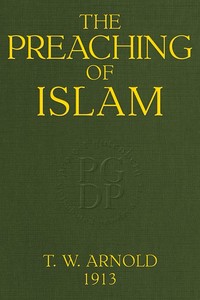
The Preaching of Islam: A History of the Propagation of the Muslim Faith by Arnold
Sir Thomas Arnold's The Preaching of Islam isn't a story in the traditional sense—there's no single plot or main character. Instead, it's the story of an idea and how it traveled across continents. Arnold sets out to trace the spread of Islam from the 7th century onward, but he focuses on the methods beyond military conquest. He acts like a historian-detective, following the trails of merchants along the Silk Road, Sufi mystics in South Asia, and scholars in sub-Saharan Africa.
The Story
The book's 'plot' is the investigation itself. Arnold systematically examines region after region—from Spain and Sicily to Persia, India, Southeast Asia, and Africa. In each place, he asks: how did Islam arrive and grow here? He consistently finds that political rule by Muslims often followed, rather than caused, religious conversion. The real 'characters' in his story are the anonymous Muslim traders whose integrity built trust, the Sufi saints whose piety attracted followers, and the appeal of Islam's straightforward message to diverse communities. He shows how Islam often spread at the grassroots level, integrating with local cultures instead of erasing them.
Why You Should Read It
I picked this up expecting a dry academic text, but I was gripped by its clear argument. In our current climate, where history is often used as a blunt weapon, this book is a refreshing, evidence-based look at a complex process. Arnold's central point—that Islam's expansion was largely peaceful and persuasive—is still powerful and relevant. Reading it, you get a real sense of movement and connection across the medieval world. It humanizes history, showing how faith spread through everyday interactions, commerce, and shared spiritual seeking. It challenged my assumptions and painted a much richer, more interesting picture than the simple 'conquest' narrative.
Final Verdict
This is a classic for a reason. It's perfect for curious readers who enjoy history, religion, or just a good intellectual puzzle. You don't need to be a scholar to follow it. If you've ever been interested in how ideas travel and change the world, or if you want to understand one of the most significant cultural shifts in history beyond the headlines, this book is for you. Just remember it was written in 1896, so some phrasing feels dated, but its core research and argument remain incredibly insightful. A truly eye-opening read.
The copyright for this book has expired, making it public property. Preserving history for future generations.
Karen Garcia
5 months agoRecommended.
Edward Perez
1 year agoFive stars!
Joshua Nguyen
7 months agoA bit long but worth it.
Charles Robinson
8 months agoHigh quality edition, very readable.





Sarah Hernandez
2 months agoExceptional clarity on a very complex subject.