
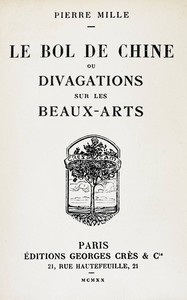
Le bol de Chine; ou, divagations sur les beaux-arts by Pierre Mille
Pierre Mille’s Le bol de Chine; ou, divagations sur les beaux-arts is a book that’s hard to pin down, and that’s what makes it fun. Published in 1922, it’s a series of connected essays presented as the author’s musings, all sparked by a single object: a Chinese ceramic bowl.
The Story
There isn’t a traditional plot. Think of it as sitting down with a very clever, slightly cynical friend who picks up an antique bowl and starts telling stories. The bowl itself is almost a side character. The real focus is on the world that swirls around it. Mille talks about the collectors who crave such objects not for love, but for status. He pokes fun at art critics who use dense, confusing language. He contrasts the simple craftsmanship of the bowl with the overcomplicated tastes of high society. Through these 'ramblings,' he paints a vivid picture of French cultural life after World War I, exploring how people use art to define themselves, impress others, and sometimes, just sometimes, to find real joy.
Why You Should Read It
I loved this book for its voice. Mille isn’t shouting from an academic podium; he’s whispering gossip in your ear. His humor is dry and his insights are sharp. He perfectly captures the silliness of social posturing, which is something that hasn’t changed a bit in a hundred years. Reading it, you’ll recognize the modern versions of his characters—the influencer, the name-dropper, the person who buys art as an investment. Beyond the satire, there’s a genuine affection for beauty itself, for the quiet skill of the anonymous artisan who made the bowl. It’s that mix of sharp observation and underlying warmth that makes it stick with you.
Final Verdict
This is a perfect book for a curious reader who enjoys essays, social observation, and a dash of history. If you like authors like E.B. White or contemporary writers like Alain de Botton for their thoughtful, accessible style, you’ll appreciate Mille. It’s also great for anyone interested in the 1920s, but from a fresh angle that isn’t all jazz and flappers. Fair warning: it’s a translation from French (if you’re reading in English), and the cultural references are of its time, but the human behavior it describes is timeless. Pick this up for a short, smart, and surprisingly funny look at why we value the things we do.
You are viewing a work that belongs to the global public domain. It is available for public use and education.
Joseph Anderson
1 month agoI was skeptical about the depth of this book at first, but the step-by-step breakdown of the methodology is extremely helpful for students. It’s hard to find this much value in a single source these days.
Robert Miller
8 months agoLooking at the bibliography alone, the concise summaries at the end of each section are a lifesaver. The price-to-value ratio here is simply unbeatable.






Matthew Taylor
10 months agoThis is now a staple reference in my professional collection.