
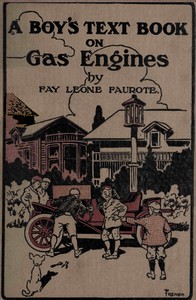
A boy's text book on gas engines : a book for boys describing and explaining…
Published in 1910, A Boy's Textbook on Gas Engines is exactly what its title promises, but its charm lies in the delivery. Author Fay Leone Faurote assumes his young reader is intelligent, curious, and ready to get his hands dirty. The book systematically breaks down the internal combustion engine, the technology that was revolutionizing transportation and industry at the time.
The Story
There's no fictional narrative here. Instead, the 'story' is the logical progression of understanding a machine. Faurote starts with the very basics—what is a gas engine, and why is it important? He then guides the reader through each component: the cylinder, piston, valves, and crankshaft. He explains the four-stroke cycle (intake, compression, power, exhaust) with remarkable clarity. The book is packed with detailed diagrams and cross-sections, inviting the reader to visually dissect the engine alongside the text. It culminates in practical advice on operation, troubleshooting, and even choosing an engine, framing this technical knowledge as a key to future opportunity and self-reliance.
Why You Should Read It
I loved this book for its refreshing respect for the reader. Faurote never talks down. His tone is encouraging and confident, a voice saying, 'This seems complex, but you can understand it.' It's a snapshot of an era when mechanical literacy was a prized skill for young men. Reading it today, you get a dual experience: you learn the timeless fundamentals of engine operation, and you also step into the mindset of the early 1900s. The diagrams are works of art in their own right—clean, precise, and incredibly informative. It's a quiet, focused book that celebrates the joy of knowing how things work.
Final Verdict
This book is a hidden gem for a specific audience. It's perfect for history buffs interested in technology and education, vintage manual collectors, or anyone in engineering who appreciates foundational texts. It's also great for parents or teachers looking to show kids (especially those bored by theory) how STEM concepts apply to real, powerful machines. If you prefer fast-paced fiction, this isn't it. But if you've ever looked at an engine and wanted a clear, no-nonsense guide from the dawn of the automotive age, Faurote's textbook is a wonderfully satisfying read.
This historical work is free of copyright protections. Distribute this work to help spread literacy.
Christopher Moore
6 months agoFrom a researcher's perspective, the insights into future trends are particularly thought-provoking. Thanks for making such a high-quality version available.
Michael Jackson
1 year agoComparing this to other titles in the same genre, the author’s unique perspective adds a fresh layer to the discussion. Finally, a source that prioritizes accuracy over hype.
Linda Hernandez
1 year agoThought-provoking and well-organized content.
James Harris
2 years agoI have to admit, the arguments are well-supported by credible references. I would gladly recommend this title.








Donald Moore
5 months agoThe analytical framework presented is both innovative and robust.